How Accounting Explains the NBA Lockout

After many weekends spent this term on accounting and missing my beloved football games, I couldn’t help but think that there must be a way to bring the two together.  Accounting and sports.  A match made in heaven?  Well, maybe not quite, but I was able to enjoy a brief break from reading the Journal Entry of the Week by looking at some financial statements that were a little more interesting.

First, let’s start with the NFL.  It wasn’t too long ago that we were all on pins and needles about the NFL lockout.  What would happen if we had no professional football?  My fantasy football league can’t play itself.  I don’t own an X-box….yet….and if I did, would seeing a virtual Dirty Bird suffice?  No, it would not.  But why oh why would these players walk?

The claim from NFL owners was that they needed to reduce the player’s salaries by 18% ($1 Billion) because there was a loss in revenue.  Was that valid?  Wellllllll, in reviewing the financial statements that were leaked revenues in 2010 are down by $21.4M from 2009.  Hmm..we’ll need to keep digging though.  Ahh…the answer to why the owners are complaining is of course in the notes.  “Note 5- Debt & G-3 Stadium Program” explains that the program that gave low interest loans to teams to build stadiums ran out of money in 2007.  So the league isn’t loaning money anymore to owners and owners have loans to repay to the league for stadiums in huge amounts.  Team revenues are down, and owners need to cut costs.  Players’ salaries account for the largest portion of operating expenses, therefore to increase Net Income, owners wanted to…cut salaries.  Wow, I think I just had an accounting breakthrough.

http://deadspin.com/5819427/exclusive-weve-obtained-audited-financials-for-the-nfl-league-office

Alright, alright, well, the NFL Lockout is a thing of the past, and I can turn on the Thanksgiving Day games and watching the nail biting Cowboys v Dolphins game.  The NBA Lockout is really what we are focusing on.  Once again, player’s salaries are on the firing line as the league claims that the teams are losing revenue.  The NBA claims that 22 out of 30 teams lost money in 2010.  So what do the financial statements reveal?  In this case, there may be some truth to the owner’s claims.  The leaked 2009 financial statement from the New Orleans Hornets the 2008 season resulted in a $17M loss.  The team recovered in 2009 with a $1.8M profit.  So you say, “Wait, they were positive again in 2009.  How’d they do that after such a bad year in 2008?”

Then you use some Schipper-like detective skills.  Salaries went down by $3M, but hmmm…what is this weird line in 2009 of “Gain on modification of relocation” in the amount of $4M increase on the Income Statement? Note 10 in the financial statements gives the answer.  When the Hornets moved from Charlotte to New Orleans they had to pay a relocation fee.  This was being paid out in installments.  However, in 2009 they were granted a deferral of $4M.  Ahhh…so without this deferral the Hornets would have been about $2.2 in the red again.  The owners also gave short term loans to the franchise, but then issued Long Term loans to repay those borrowings (see Note 15).  Hmmm…I dunno…on the fence on this one.

http://www.atthehive.com/2010/12/7/1862259/the-hornets-financial-statements-the-hornets-have-been-unprofitable
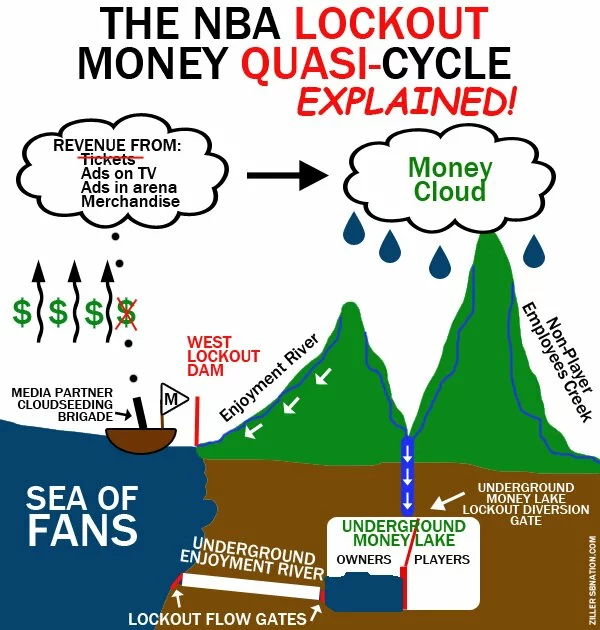
I’m not happy so far because accounting is explaining way too much of this story.  Salaries, salaries, salaries.  Let’s see if accounting can explain this.  Is the salary cap a bad thing for all of these professional sports programs?  Well, actually, it could be helping the players make bigger bucks.  Allan Sloan, from Fortune Magazine, says that salary caps are actually just creative accounting designed to lower the average salary reported out each year.  One year you have a big salary next year a low salary, so on average you report out a lower salary.  As I suspected, accounting is to blame.  That was the answer I was looking for.  Now I’m going to go see if I can remember what my pillow looks like.

http://www.marketplace.org/topics/business/creative-accounting-helps-sports-teams-stay-salary-game

Humble Pie

I’ll take my turkey with a side of humbleness. That’s my feeling heading into the Thanksgiving Holiday this week.

I think a dose of humble is the biggest thing I’ve taken away from Term 2 so far, that I’m not quite as awesome as I thought in some areas. I think those in our program have a decent amount of self-confidence. I wouldn’t say it’s a prerequisite but it helps a lot in being successful and having the drive to take on not only work but a big load with school. It means we are confident in our abilities to get crap done when we need to.

For me, Term 1 was a little tough but nothing too much to sweat about. I had heard rumblings through this blog, from admins and professors in Term 1, and through the grapevine that Term 2 would be a different animal. Well here we are and boy is it! The funny thing is, it isn’t the class I was warned about that I’m humbled by, it isn’t intro to accounting that’s giving me fits. I’m a CPA, so that means I’m familiar with accounting. It doesn’t mean I’m an expert as CPA can mean you are in finance, taxes, management, consulting, government, or so many other areas. Still, I do have an advantage. So with that, I feel comfortable with most of the accounting. It takes a TON of time even so, but it isn’t anything compared to the exams I took to get my license.

No, it isn’t accounting that has me sweating, it’s Decision Models. It’s actually amusing, when I step away from it and look at how I’m doing, that I’m like the proverbial monkey with a typewriter as I work with Excel to develop my models. I feel like if I tweak this or that, maybe something coherent will come out of it. I’ve gone so far as to find a stupid book on Crystal Ball! Ugh, I have to find the time to work through that. The frustrating thing is I actually find it interesting but I am still having issues with it. I get the concepts after I look at the solution, but coming up with a plan of action ahead of time has been quite a challenge. The grades to date came out today and I’m barely, oh so barely, near the average though I’m on the bad side of that average. The thing is, when finals come around, I’m screwed unless I seriously get my act together.

So with that being said, I know where I’m at but I’m also capable of working on things. Here’s the part that I think many others in our program share: we see a problem and we tackle it head on. So yeah, I’m underwater with DM, but I know that and I’m confident that I’ll somehow learn to at least tread water, or even learn the rudiments of doggy paddling, by the time we hit the final. I won’t drown, I’m sure of that.

What’s the point of this post? Well I got my piece of humble pie, but I’m also confident enough to know that I can work through this. I bet a few others are in the same spot. Well we can get through this like we have with other big challenges we’ve faced in life. Just know that those facing this avalanche of work aren’t alone, that others are going through the same thing, and that you will get to the other side so we can celebrate in Dubai. See you on the other side of Term 2! Alright, back to the case studies…

P.S. To those having fits with accounting: To get through the accounting stuff, I’d seriously suggest looking over the class slides and watching the classes again (I’ve listened to the lecture twice in prep for the case). There is gold there for getting through the case work and in prep for the final. I think of the book as a place of last resort as I get lost in there more often than not. Just my two cents on that.

A New Direction – The MBA

As this is my first post, I thought I would give a bit of background. Please bear with me as I’m new to this. I’ve had a whirlwind of a time with the MBA application process and I’ll start out from the beginning. In much the same way that Randy Zwitch began this blog back in 2009, I first had to decide on a direction.

So my background is a tad unorthodox. I did a fine job on my undergrad at a local school and graduated with my bachelors…in European History. Now, at that time, I thought teaching was the direction for me. After a few years, I figured out it certainly was NOT the direction for me. I love to teach, but kids’ parents are annoying, admin is a joke, and the pay is absolutely insane (in a very bad way). So a career change was in order.

Looking around, I figured I would give business a shot. I landed a job as a secretary of all things. I did well at my job, though I’ll admit part of that is I’m very good at looking busy/intelligent/industrious. I know how to work when I need to, but I also know how NOT to work. After a couple of years, and a few promotions, I was the office manager of a nice little consulting firm in S.F. Now I had the problem of hitting a ceiling. In that position, there wasn’t much higher I could climb. Darn it all to heck and back, I was frustrated (I’m a tad ambitious)!

So, again looking around, I thought of how I was good at using my company’s accounting software and seemed to just ‘get’ numbers. Now why I ‘get’ numbers is beyond me, but I find myself counting random things in a meeting. If someone is throwing around numbers, I naturally start adding them, or doing something with them mentally. Also, not that I really understand it, but according to those funky tests you take in school for aptitude, I seemed to always score high with pattern recognition and pulling order out of seeming chaos. Whatever.

Now, knowing I had a knack for numbers and such, I thought accounting was the way to go. So I jumped right off that safe (and highly overpaid) bridge to take a big pay cut as a lowly bookkeeper. At the same time I was back in school taking a huge number of courses (working and going to school full time is NO joke) to prep for the CPA (did I mention that I’m ambitious?).

Fast forwarding a few years, I now have my CPA, an additional piece of paper as a CFE, and am manager of my company’s accounting department. Quite a jump in only a few years (stupid ambition). The problem is, I don’t know what the heck I’m doing half the time (remember my comment earlier about my skills at looking industrious?). The accounting is fine, though I could wish for more challenges. My weakness is the management stuff. I just don’t seem to get it. So, once again, I’m looking for a way to fix this and came up with the idea of an MBA.

In the early part of the summer of 2010, I was meeting with my boss and, as we often do, our conversation was all over the place. We talked about our projects, our clients, our company’s current cash flows, etc. I mentioned to him that I had been thinking about going back to school for my Master’s. I am already a CPA as well as a CFE (Certified Fraud Examiner) so I imagined that an additional degree couldn’t hurt. When I said that an MBA might be a possibility, he jumped at the idea. I went back to my desk and started doing some serious research on the MBA. I found out what I had to do, which schools made sense for me, and all the little bits I’d have to take care of to start down this new path. I know there are holes in my knowledge, I admit them, and am very motivated to fix this.

What I find interesting in this process is how each of us as students came to the decision to pursue the MBA. As you can see above, the journey to my decision was a long one. I’d be interested in hearing from others on how they decided to go this ambitious, challenging, and dare I say costly direction.