How Accounting Explains the NBA Lockout

After many weekends spent this term on accounting and missing my beloved football games, I couldn’t help but think that there must be a way to bring the two together.  Accounting and sports.  A match made in heaven?  Well, maybe not quite, but I was able to enjoy a brief break from reading the Journal Entry of the Week by looking at some financial statements that were a little more interesting.

First, let’s start with the NFL.  It wasn’t too long ago that we were all on pins and needles about the NFL lockout.  What would happen if we had no professional football?  My fantasy football league can’t play itself.  I don’t own an X-box….yet….and if I did, would seeing a virtual Dirty Bird suffice?  No, it would not.  But why oh why would these players walk?

The claim from NFL owners was that they needed to reduce the player’s salaries by 18% ($1 Billion) because there was a loss in revenue.  Was that valid?  Wellllllll, in reviewing the financial statements that were leaked revenues in 2010 are down by $21.4M from 2009.  Hmm..we’ll need to keep digging though.  Ahh…the answer to why the owners are complaining is of course in the notes.  “Note 5- Debt & G-3 Stadium Program” explains that the program that gave low interest loans to teams to build stadiums ran out of money in 2007.  So the league isn’t loaning money anymore to owners and owners have loans to repay to the league for stadiums in huge amounts.  Team revenues are down, and owners need to cut costs.  Players’ salaries account for the largest portion of operating expenses, therefore to increase Net Income, owners wanted to…cut salaries.  Wow, I think I just had an accounting breakthrough.

http://deadspin.com/5819427/exclusive-weve-obtained-audited-financials-for-the-nfl-league-office

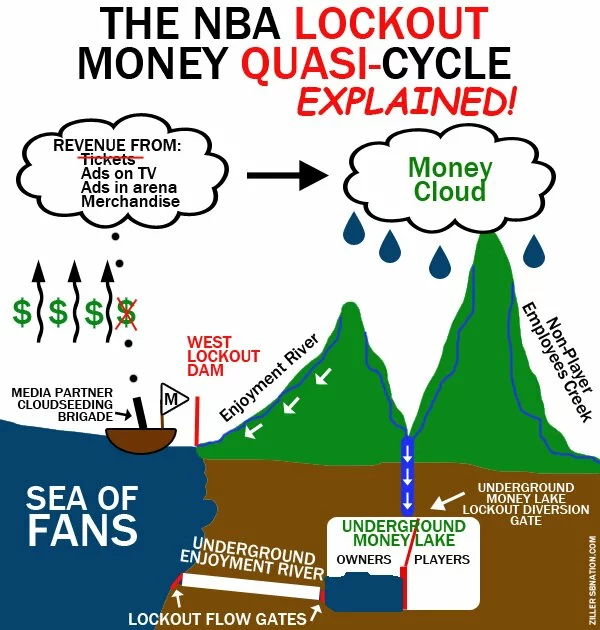
Alright, alright, well, the NFL Lockout is a thing of the past, and I can turn on the Thanksgiving Day games and watching the nail biting Cowboys v Dolphins game.  The NBA Lockout is really what we are focusing on.  Once again, player’s salaries are on the firing line as the league claims that the teams are losing revenue.  The NBA claims that 22 out of 30 teams lost money in 2010.  So what do the financial statements reveal?  In this case, there may be some truth to the owner’s claims.  The leaked 2009 financial statement from the New Orleans Hornets the 2008 season resulted in a $17M loss.  The team recovered in 2009 with a $1.8M profit.  So you say, “Wait, they were positive again in 2009.  How’d they do that after such a bad year in 2008?”

Then you use some Schipper-like detective skills.  Salaries went down by $3M, but hmmm…what is this weird line in 2009 of “Gain on modification of relocation” in the amount of $4M increase on the Income Statement? Note 10 in the financial statements gives the answer.  When the Hornets moved from Charlotte to New Orleans they had to pay a relocation fee.  This was being paid out in installments.  However, in 2009 they were granted a deferral of $4M.  Ahhh…so without this deferral the Hornets would have been about $2.2 in the red again.  The owners also gave short term loans to the franchise, but then issued Long Term loans to repay those borrowings (see Note 15).  Hmmm…I dunno…on the fence on this one.

http://www.atthehive.com/2010/12/7/1862259/the-hornets-financial-statements-the-hornets-have-been-unprofitable

I’m not happy so far because accounting is explaining way too much of this story.  Salaries, salaries, salaries.  Let’s see if accounting can explain this.  Is the salary cap a bad thing for all of these professional sports programs?  Well, actually, it could be helping the players make bigger bucks.  Allan Sloan, from Fortune Magazine, says that salary caps are actually just creative accounting designed to lower the average salary reported out each year.  One year you have a big salary next year a low salary, so on average you report out a lower salary.  As I suspected, accounting is to blame.  That was the answer I was looking for.  Now I’m going to go see if I can remember what my pillow looks like.

http://www.marketplace.org/topics/business/creative-accounting-helps-sports-teams-stay-salary-game

Business Savvy vs Scammy Business

This was supposed to be a whole other blog post about One Year Ago – when the CCMBA Class of 2010D flew off to London all bright-eyed and full of wonder, not knowing the bitter trials and tribulations that would go with Discounted Cash-Flow analysis and Monte Carlo simulations.

I actually started writing that post, but as fond memories of debits, credits and failed attempts to get Partial Credit from the Financial Accounting final rushed into my brain, I decided to stop and check Facebook.

Just a bit under a year ago, as CCMBA 2010D was wrestling with Accounting Finals, the countdown timer edged closer to zero when – yegads! – the Learning Platform breaks down, preventing on-time exam submissions. Red flags are raised; the Bat Signal is fired up; Moscow rings Washington DC which promptly confirms with Durham NC to make sure that Armageddon is averted.

Meanwhile, somewhere in Shanghai, I go back to playing Mafia Wars.

I should have probably used that time more wisely and gone back through my answers, but this was at the tail-end of a 24 hour struggle against the forces of evil (the IASB and FASB). I was sleep deprived, and my body was going haywire on what has proven to not be the last of a string of caffeine overdoses.

At that point, I was physiologically incapable of caring any less – the more pressing goal was to reach for something less intellectually demanding, and more immediately gratifying. I needed to reach for… reach for Level 50.

So yeah, Facebook and Mafia Wars.

Funny thing is I haven’t touched that game, since. Or any other Facebook game for that matter… until I started putting things together for Ye Olde Blogge Poste, got sidetracked and decided to log on to Facebook. My current high-score on Bejeweled Blitz is 437,000.

The last 12 months of business education must have paid off, because I just felt myself getting increasingly bemused with the number of gimmicks thrown by these game companies left, right and center. First they pull you in with bright colors, happy-smiley cartoon figures and (again) immediate gratification via a proprietary delivery-system made up primarily by repetitive mouse-clicking…

And then they monetize it.

So, some things I’ve noticed before, but didn’t “really” take notice of:

1.)    Bundling dynamics. 5 golden coins for 5USD, or a power-up for 5 USD, or 5 golden coins AND a free power-up for the next 3 games for 10USD. Dan Ariely would be proud.

2.)    Free advertising and lead generation. Invite your friends! Free stuff! Brag about your new high-score! Free tokens. Just how cheap can lead generation get?

3.)    Low buy-in. Everyone’s got a marginal utility curve. You can buy an iPad for the 500USD you will have in 6 months, or you can buy Texas Hold’Em Poker chips for the 5USD you do have now. Equal happiness? Click! Cheap and immediate gratification.

4.)    Process flow analysis. You have 30 minutes ‘til your carrots are ready to harvest. Idle time? Thankfully you’ve got a whole link bar of other games, just above the fold. Don’t be a bottleneck! Click on them and make yourself useful for those next 30 minutes.

5.)    The Freemium concept. All levels are free to play for as long as you want. However, some of the bosses can only be defeated using super special weapons. Click here and buy now! Click! Cheap and immediate gratification.

Now, just to clarify, I find absolutely nothing wrong with the things I’ve mentioned above. It’s a business, and businesses are meant to make money. There’s nothing fundamentally wrong with monetizing search (ask Google!), so there should be nothing fundamentally wrong with monetizing time wasting activities. Then again, my head might be confusing “wrong” with “illegal”.

I guess, the question now becomes is there a line between having acute business savvy and being a slimey, scummy 2.0 version of a snake oil salesman?

When does knowing how to make money out of other people’s psychological predilections for obsessive compulsive mouse-clicking turn into a vile and devious form of revenue management which depends on App emails telling people that someone’s got a crush on them?

Hey, it’s money!

People might not like you, but you can’t argue with success.

Seeing as I see nothing wrong with above-mentioned activities, should I even be thinking out loud?

Yeah, maybe. Someone email me, quick! I need to get some more ideas on monetizing leads and how to increase my own CTRs!!!

A Short Introduction to Bookkeeping

I live in a rather nice flat right in middle of Shanghai. It’s a very well laid out 3-bedroom apartment that’s warm in the winter and, as I am just finding out, surprisingly cool in the summer. It’s got 2 balconies and an excellent view overlooking Suzhou Creek. It’s cheap and the water heater works perfectly!

I love this place; everything is great about this place – everything except the furniture. It’s horrid. It’s faux 18th century French country in a ghastly array of curves and carvings, plastered in white and silver. It’s the kind of furniture that your grandmother would feel old in. Contrasting it with the minimalist feel of the kitchen and the bathrooms, the sofas and the dining set fit in about as much as roaring flatulence does at the orchestra.

To try and alleviate this situation, I made a quick visit to IKEA over the weekend and got myself one of those nifty 3 section dressers that only come in one color: wood.  Did the trick; was amazed at being able to put in all of my life’s possessions into 3 cubic meters.

The bottom shelf space I allocated for my MBA stuff – books, binders, handouts and CDs that I’m sure will come in handy one day. I even managed to save a special space for my copy of Financial Accounting, signed by none other than K-Schip herself, Katherine Schipper.

Sifting through those 3 million kilos of learning material, I was surprised at just how much we’ve managed to intellectually digest over the course of the last 10 months. However, what I found even more surprising was the amount of material that we DIDN’T even mention (not even tangentially) in class.

This isn’t to say that the work load was trivial – au contraire! – we, or at least I rather, have actually on more than one occasion physically felt my brain rap against the inside of my skull telling me to “Stop! For the love of God, stop!”

We’ve so far gone through 6 sets of faculty-generated class slides and you can basically cruise through the program studying just those handouts. Mind you, cruising and doing some actual learning are 2 different things altogether, but it’s amazing how much you can learn if the study material was made by your professor specifically for your class.

This is my first exposure to “proper” Western-style education; I’ve never had the opportunity to have everything laid out in front of me with simple, one-sentence explanations. I’ve always had to slog through 20 pages from the course textbook only to find out the next day that the Prof could explain things in 45 minutes. No class notes though!

Here, with the Fuqua CCMBA Program it’s almost too tempting to not do any real work and just depend on those pre-prepared slides. Makes you think though, if this program is timed to be exactly like the regular Daytime Duke MBA Program – in the greater scheme of all things business, just how much are we all really learning?

Not nearly enough, I’d say. But then what we’re currently going through is already more than enough. And what we’re learning, we’re learning properly. I can count on one hand the number of open-notes exams I’ve had in my life -  and the number of heated arguments I’ve had with my undergrad professors (“So, what you’re trying to say is that when I’m already working, my boss is going to hide all my books?”) I nary have enough digits.

This experience with the Cross Continent MBA has underlined what I’ve always thought important about education – understanding the theory behind the process, not memorizing the process itself. Books don’t give you learning, good teachers do. Or at least those who take time to create class slides.

As for the books that are now neatly stacked one on top of another (again, except for my signed copy of Financial Accounting which has its own slot), I’m a bit disappointed that the 120K USD tuition covered them and I wasn’t even able to properly use them but I think I’ll have to get myself some proper shelving space and keep these readily available or the next 64 years – as I plan never to retire and die suddenly, and without warning, at the age of 92.